

What is Graph theory?
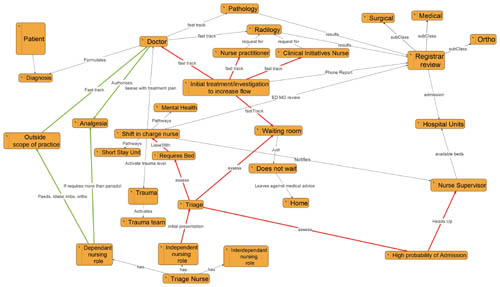
Opposite is a Graph of a surgical nurse.
Buckle up
In Information Science, Graphs can be used to model many types of relations and processes in physical, biological,social and information systems. Many practical problems can be represented by Graphs.
Emphasizing their application to real-world systems, the term Graph is sometimes defined to mean a diagram in which attributes (e.g. names) are associated with vertices and edges,
that is, names are associated with things and their relationships in some domain of interest (some culture)
A Graph expresses and understands real-world systems as a network.
An ontology is used in Graph theory to represent a structured framework for knowledge within a domain.
Unlike traditional databases or hierarchical taxonomies, ontologies allow for complex, multidimensional connections, making them especially valuable in fields where nuanced relationships drive decision-making.
More simply, ontology connects objects and concepts through defined relationships, creating a model that enables better data organization, interoperability, and intelligent automation.
The term 'ontology'originates from philosophy, where it refers to the study of being and existence.
In the context of information systems, ontologies provide a logical structure for understanding and categorizing information, making them must-haves for AI, enterprise knowledge management, and search technologies.
Mathematically, ontologies are built on graph theory, which models relationships between entities using nodes and edges. Think Facebook et al.
That is all very nice, but what is it good for?
Instead of an unhelpful taxonomy of things. My research is about making Graphs do useful things, especially, reflecting the classic notion of graphs as a 'snapshot' of reality.
Such as:
Graphs are consumable knowledge which can be stored, this means, processes are not lost if a key member leaves the organization.
Process modulation:
Graphs may be used to add, or delete redundant processes, thus improving patient outcomes and productivity.
Instructional tool:
Graphs may be useful as evidence to show managers where resources/money could be better placed.